
OVERVIEW
Before ProcessBay existed as a firm, its founding methodology was forged inside one of the most complex operating environments on earth — the upstream gas operations of one of the world’s largest national energy companies.
This case study documents the work that became the architectural foundation of ProcessBay’s approach: how a structured process architecture methodology — later generalized as the Skyscraper Model — was designed, tested, and proven at scale inside a major energy conglomerate.
The results included record-breaking safety compliance scores, zero major incidents sustained over three consecutive years, and enterprise-wide adoption across 25 operational departments serving approximately 20,000 personnel.
More importantly, this work demonstrated a core thesis that ProcessBay was built on: when you define what constitutes a process, structure it with discipline, and embed it into the culture of an organization, the performance follows. This is not a technology story. It is a story about execution architecture.
Service Type
Operational Excellence | Safety Management Transformation
Key impact
The Context & Challenge
A corporate transformation without an execution playbook
A major energy organization shifted from prescriptive compliance to a performance-based Safety Management System. The intent was strong — but departments were left without a practical method to translate the framework into local, usable execution.
Core insight
The problem wasn’t commitment to safety — it was the absence of execution architecture.
Departments needed a repeatable, non-negotiable structure for defining, organizing, and sustaining safety management processes — so performance could become a property of the system, not individuals.
What changed
- Performance-based SMS
- Corporate moved from detailed HQ-written procedures to an 11-element Safety Management System manual.
- Facilities were expected to implement locally based on unique risk profiles.
- Execution quality depended on each department’s interpretation and documentation approach.
Why performance slipped
- Architecture gap
- No shared definition of what a “process” is (vs. procedure, program, or policy).
- No minimum structure for a well-written, sustainable management process.
- Processes were fragmented, inconsistent, and hard for field teams to use.
What it looked like
- Below 70% scores
- High effort, uneven outputs — large documents or overly brief templates.
- Misalignment between strategy direction and compliance measurement created confusion.
- Corporate reviews repeatedly scored departments below 70%
The Diagnosis
Why early safety management
systems kept failing
A structured review of enterprise implementations showed the issue wasn’t effort or commitment — it was the absence of a practical, standard definition of what a “well-built process” looks like and how a complete system should be organized and sustained.
Before designing a new approach, teams examined corporate expectations, scoring worksheets, and real department SMS configurations across upstream and downstream operations.
Across the enterprise, departments converged on a few “common patterns” — each one logical, but each with structural weaknesses that made systems hard to use, hard to govern, and hard to sustain.
- Inconsistent Performance-based SMS
- Fragmented process definitions
- Low usability for field teams
- Weak ownership & measurement
Diagnostic conclusion
Departments were not failing due to lack of effort. They were failing because there was no standardized, practical answer to a deceptively simple question: what does a sustainable, implementable safety management process actually look like?
Root cause pattern
The gap was architectural: unclear “process” standards, weak system organization, and inconsistent governance — producing systems that were hard to execute and harder to sustain.
Failure category 1
System development deficiencies: incomplete systems, incomplete processes, poor accessibility/structure, and misalignment with corporate expectations.
Failure category 2
System implementation deficiencies: unclear ownership, inconsistent use, weak training definitions, limited monitoring, and absent measurement mechanisms.
What this unlocked
A clear need for a non-negotiable process standard and a navigable system architecture — the foundation for the Skyscraper Model introduced next.
The Approach
The Skyscraper Model
A visual process architecture: the system is one integrated structure, each element is a “building,” and each management process is a “floor” built to a consistent standard.
Foundational Principles
Process-first: a process is the core building block. Define it clearly vs. procedures/programs.
Architectural coherence: organize all processes under the SMS elements. Make the system navigable.
Minimum quality standard: every process follows a consistent structure. No “partial” processes go live.
Self-sustaining by design: embed ownership, measurement, and review. Survives turnover and change.
10 Mandatory Components
The Process Standard
A single, consistent structure that every management process must include — ensuring completeness, ownership, usability, and measurable governance across the Safety Management System.
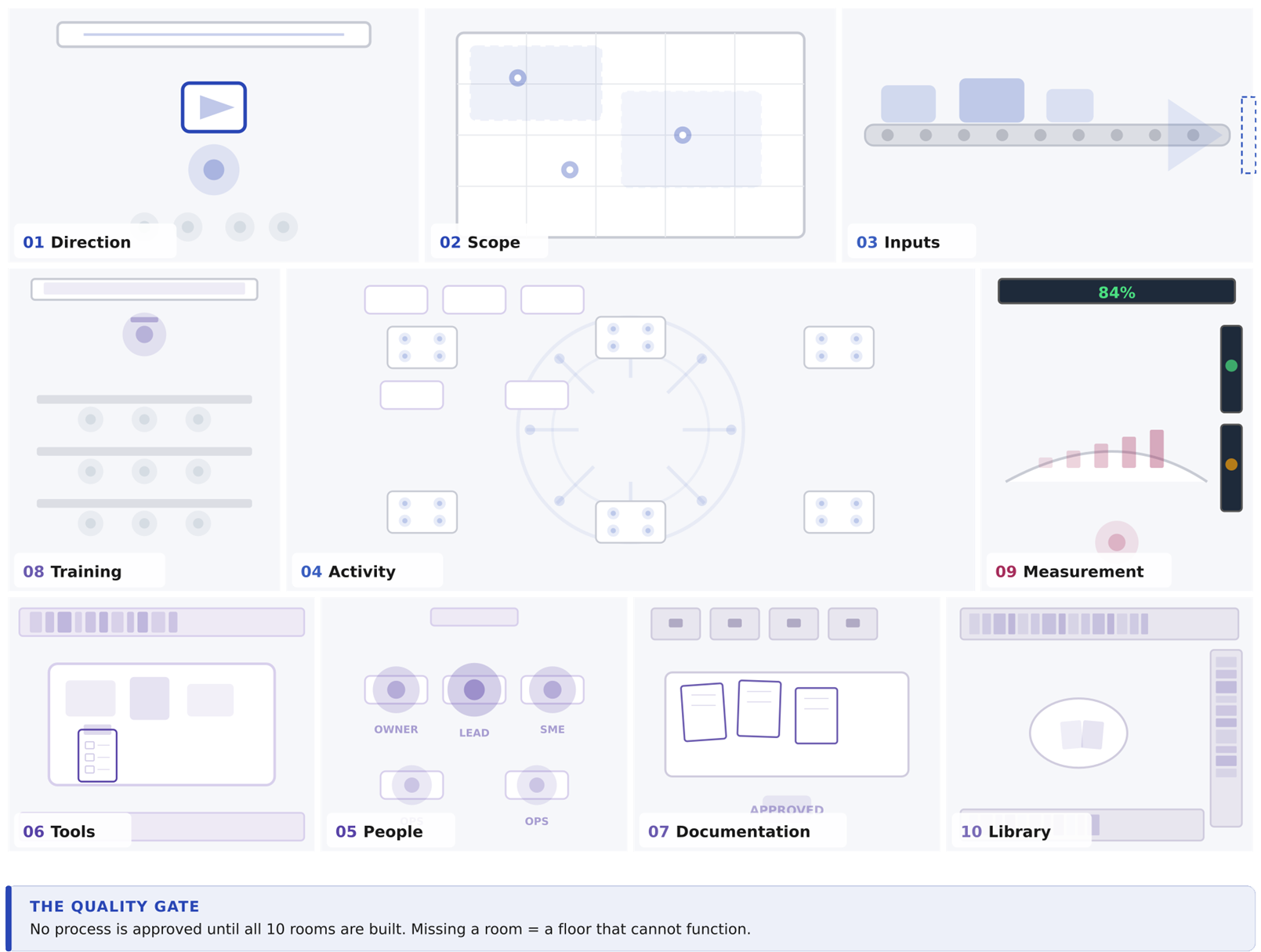
Purpose & scope
Applicability
Process Description
Required
Training
Applicability
Performance
Indicators
Attachments
Responsibilities
Output
External References
Purpose & scope
Why the process exists and where it applies.
Define the objective, boundaries, who it applies to, and what is out of scope.
Definitions & references
Shared language and governing requirements.
List key terms and link standards, policies, regulations, or internal references.
Roles & responsibilities
Ownership, accountability, and interfaces.
Clarify process owner, performers, approvers, and cross-functional dependencies.
Inputs & triggers
What starts it and what it needs.
Define trigger events, required inputs, and where inputs come from.
Process steps
The workflow from start to finish.
Describe the steps, decision points, handoffs, and required sequencing.
Outputs & deliverables
Required outcomes and artifacts.
Specify outputs, templates, records, and where they are stored or reported.
Controls & verification
Checks, approvals, assurance points.
Add quality gates, review steps, approvals, and verification activities.
KPIs & monitoring
How performance is measured.
Define KPIs, thresholds, reporting cadence, and who reviews performance.
Training & competency
Skills required to execute correctly.
Specify required training, competency checks, and onboarding requirements.
Review & improvement
Change control and continuous improvement.
Define review frequency, audit links, improvement workflow, and version control.
From Model to Movement
Implementation
The methodology was not deployed as a top-down directive. It was built collaboratively, tested iteratively, and embedded through a deliberate capability-building strategy.
Phase 1 - Foundation Building
Build shared language for risk and process thinking before writing a single process.
- Designed and delivered a 3-day intensive risk management workshop in small cohorts.
- Senior leaders joined key sessions to transfer operational context and visibly sponsor the shift.
- Established a common vocabulary for risk, ownership, governance, and process design.
Phase 2 - System Development
Architect the full SMS as one coherent system, then build processes to a clear quality standard.
- Mapped around 140 candidate processes across the 11 SMS elements and refined them to 115.
- Trained cross-functional process developers on the model and quality expectations.
- Assigned process ownership close to the work and introduced structured end-user feedback.
Phase 3 - Implementation and Cultural Embedding
Turn documents into behavior through targets, governance, ownership routines, and measurement loops.
- Linked leadership annual safety targets to SMS execution.
- Formalized process owner duties to coach, monitor, update, and improve.
- Activated KPIs, reporting cadence, evidence trails, and continuous review.
Phase 4 - Stabilization and Performance
Normalize routines through review cadence, audit readiness, and continuous improvement as standard work.
- Institutionalized review cycles based on findings, incidents, and field feedback.
- Improved templates, links to tools and forms, and evidence capture.
- Strengthened audit and compliance readiness through disciplined ownership follow-through.
Phase 5 - Enterprise Adoption
Validated locally, then introduced at scale so the model became a reference approach across departments.
- Facility results established the plant as a reference model for SMS process development.
- Methodology introduced across 25 departments and around 20,000 personnel.
- Departments adopted the model locally because of its clarity, practicality, and repeatable structure.
The Results
Measurable, Verified, Enterprise-Recognized
Facility results were measurable and sustained, enabling enterprise-level adoption and external validation through peer-reviewed publication and conference presentation.
Facility-Level Outcomes
- Highest recorded at the time
Enterprise reference model: Recognized by the corporate upstream business line as the benchmark for safety management process development.
Enterprise-Level Adoption
- Business-line expansion
External Recognition
- Peer-reviewed
Peer-reviewed publication
Formal documentation created an independent, verifiable record of the work and outcomes.
IPTC — Beijing
Presented at the International Petroleum Technology Conference.
ASSE — Bahrain
Presented at the American Society of Safety Engineers conference.
The Thesis That Built ProcessBay
Organizations do not fail because they lack strategy. They fail because they lack the execution architecture to make strategy repeatable. ProcessBay exists to close that gap — with methodology proven at the scale and stakes of global energy operations.
What Transferred
- 1
ASSE — Bahrain
Generalized beyond safety into a universal process architecture: each “building” is a business element and each “floor” is a management process. The name ProcessBay originates from the “bay of skyscrapers” visual.
- 2
10-Component Standard
Adapted for consulting, operations, and venture-building while preserving discipline around purpose, accountability, steps, tools, training, measurement, and documentation.
- 3
Implementation Philosophy
Collaborative development, capability building before deployment, process ownership at execution level, and governance structures that sustain outcomes.